

Chapter 8: Self-Editing – The First Round
The Complete Short Story Writing Textbook for Beginners
If you’d prefer to get all chapters at once, download the ebook (PDF) version of
The Complete Short Story Writing Textbook for Beginners
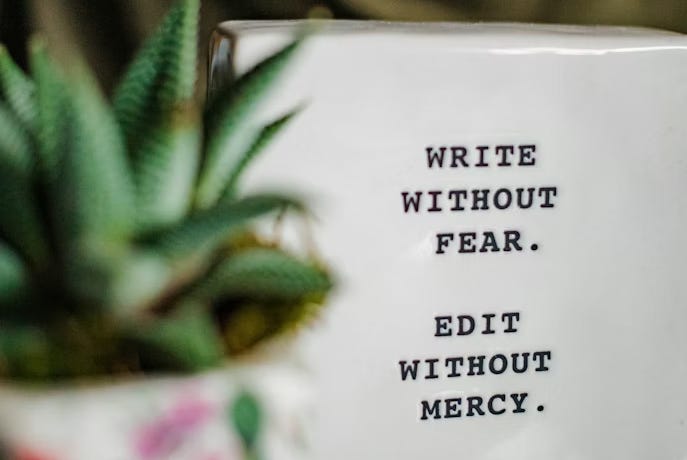
The “Plot or Character?” Test That Cuts 30%
If you followed Chapter 7, your draft has been cooling for 1-2 weeks. Perfect.
Now the fun part: editing.
Most writers tinker endlessly. This chapter: one brutal test that cuts 20-30% of your draft and makes it twice as strong.
Every sentence must pass this test or get deleted. No mercy.
The Fundamental Editing Question
For each sentence, ask:
Does this sentence either:
Move the story forward (plot), or
Reveal character?
If “no” → delete.
Short stories have zero room for sentences that do neither.
1. Cut Clarifying Overkill
Trust your reader. Once established, facts don’t need repeating.
Bad:
“Ann, his girlfriend, walked in. John looked at Ann, his girlfriend, and smiled.“
Better:
“Ann walked in. John smiled.“
We get it. Move on.
2. Spot Repetition of Ideas
Two sentences saying the same thing? Keep the stronger one.
“She was terrified. Fear gripped her heart.“
→ “She slammed the door.“
One image > three statements.
3. Show, Don’t Tell (The Sharp Version)
Telling: “He was nervous.“
Showing: “His key missed the lock twice.“
Telling: “She was angry.“
Showing: “Plates cracked against the counter, silencing the table.“
Hunt emotional adjectives. Replace with behavior.
4. One Strong Detail > Four Weak Ones
Overloaded:
“She tapped her foot, chewed her lip, twisted her ring, glanced at the door.“
Better:
“Her eyes flicked to the door every ten seconds.“
Precision beats clutter.
5. Simplify Dialogue Tags
Dialogue does the emotional work. Tags just say who.
Weak: “I hate you,” she screamed furiously.
Strong: “I hate you,” she said.
The line itself screams.
6. Cut Pretty but Empty Description
Ask every descriptive passage:
Mood? Character? Foreshadowing?
Just pretty? Cut.
“The sunset bled orange across the sky“ → only if the blood color matters.
7. Kill Passive Voice
Passive: “The glass was broken by Tom.“
Active: “Tom broke the glass.“
Hunt “was [verb]ing” constructions.
Exercise: 10% Cut Challenge
Take word count. Cut 10% minimum (plot/character intact).
Target:
Repeated ideas
“Just/very/really”
Over-explaining
Your story gets sharper, not thinner.
This Chapter’s Action Step
Print your cooled draft. Red pen. Read aloud.
Highlight sentences that FAIL “plot or character?“ Cross them out.
Aim: 10-20% shorter.
(Pro tip: Read aloud catches 90% of clunky phrasing.)
The 10% Cut Challenge Checklist You can download (together with the entire book PDF) at this page:

❤️ If a character just came alive for you | Forward to a writer friend
What’s Next?
Chapter 9: Advanced editing – dialogue audit, pacing fixes, emotional truth checks. (Where good stories become great ones.)
P.S. Great editing feels like violence. Protect every word like it’s your child, then kill half of them. The survivors are stronger.
❤️❤️ if you’re committing to wait | Forward to an impatient writer friend.
Eventually, you could buy me a coffee to help me concentrate better when writing the next chapters.

Thank you so much for reading! I really hope you find this helpful!